Sunday, July 11, 2021

Self-reliance and rural living

When you hang around people accustomed to city life, be they conservative or liberal, there are certain things taken for granted and certain stereotypes bestowed upon those in rural areas.  I have moved between these worlds during different chapters of my life.  I want to provide some context about my experiences prior to sharing the insights I have gained from these variations of America.  Today I am writing from our Apache County homestead.


I've been fortunate to live in owned homes most of my life.  I lived in rented units for perhaps 1.5 years during college and during transitions (moving). I have never lived in the inner city where it is very densely populated (like in New York) - where condos or apartments are the norm for housing.  I have lived in a condo - multi-unit dwelling - for about 4 years during college, but we owned it.  During the time we were full-time RV'ing we paid lot rent (meaning we didn't own the land, but we did own our RV).  Our longest term lot rental is in Mesa, AZ in a manufactured home community.  Many of the manufactured homes are rented and there are a number of full-time RV sites sprinkled throughout the community. Here is the view from our window into our neighbor's yard.   


The first 10 years of my life I lived in a neighborhood with fenced city yards dividing property lines of houses right next to each other.  Our back yard bordered a public elementary school parking lot.  The next 9 year my family moved to a rural setting.  We could see our neighbors, but there was nature between us.  For some years we had a larger piece of land (maybe an acre or more) and it bordered state land - all woods.  From there we moved closer to a rural village.  The houses were still very spread out, but they were slightly more dense. Here is a picture of camping in the woods in Michigan. 


When I moved out of my parents' house I moved in with Husband and we lived in East Lansing, MI to attend college.  I think this was the most dense urban setting I have ever experienced.  In 1997 we moved to Arizona - to the megalopolis that makes up the greater Phoenix area & we stayed there (in various houses) for 9 years.  However we also purchased our land in Apache County in 1998 and started making regular camping trips.  Our land is located in a frontier community - which is even more rural than a rural community.  In my field (public health) the difference between rural and frontier is determined by the number of medical professionals per capita.  There are other ways to classify rural vs. frontier - for instance access to fresh food/grocery stores is often used.  Another classification uses population density and high geographic remoteness.  By all measures Apache County is frontier.  In 2006 we moved to the county seat of Apache County and we stayed for three and a half years.  Here is a map from the Arizona Department of Health services that shows the breakdown of urban, rural and frontier communities in AZ.  Apache County is a long slice of the Northeast part of the state.  Most of the county is Navajo Nation, but the Southern part (labeled Springerville/Eager) is off the reservation.  The whole county is considered nonmetro.  From there we moved to a rural community (Florence, AZ) for 7 years, did full-time RV'ing in urban/rural/frontier places for just over three years and then started making the transition to living at our homestead.  So here is an approximate breakdown of my time living in various settings:

  • Urban: 22 years
  • Rural: 18 years
  • Frontier:  5 years
So, as you can see I am more of a country girl than a city slicker!  However, from the perspective of people who were born and raised in this area I am from the city.  My point: because I have had both experiences I don't really belong fully to either group.  This is valuable to me because I can pick and choose from the values of each group to knit my own identity.


So now to discuss fundamental insights I have gained from these varied experiences living and working in urban and rural environments - because the cultures are very different.  Also, because I have clearly chosen the rural life over the urban, and because most media portrayals of rural life are produced by urban dwellers I prefer to highlight the values embraced by many rural dwellers.  If you have not read "Walden" by H. D. Thoreau, I highly recommend it.  He really grasps the value of living closer to nature.  To be honest I don't think all rural folks would think of it this way - but they certainly don't want to see buildings and pavement all over the place.  We value the view, we value the animals that survive on the land.  Sure, cities are good to visit if you need to shop at a number of different places, but for the most part living near stores is not worth losing the view.  The soul can breathe in a less populated place - the facades we wear when we interact with too many people are forgotten.  People are less polished, more genuine, interesting, and have grit.   With my city co-workers I hear about their vacations to rural areas - but they are tourists - they have not lived the experience so they have not let the lessons of rural living become a part of themselves.  


Let's not forget that mere generations ago our forbearers lived with nature - how far back in your family tree do you have to go to find a farmer, rancher or other rural dweller?  For me it was my great-great grandparents.  Husband's grandfather raised cattle and commuted to the city to work in a factory.  Cities only gained popularity over the past two centuries and now a bit more than half of the world's population lives in cities. This trend raises serious questions around sustainability because the urban dwellers live in an artificial world divorced from food production, energy production, water management, housing development.  Urban residents contract out all of their basic needs (food, water, shelter, electricity) and would struggle mightily to provide for themselves.  From my observations rural residents are generally more self-reliant.


Returning to the notion of grit (and yes, I love the movie True Grit) I have learned what grit is when providing for myself - growing food, preserving and preparing food without fossil fuels, setting up a solar power plant, plumbing a solar water system, building a house.  Because services are scarce in rural areas, rural residents learn to take care of themselves.  They push through adversity, try different things & develop creative problem-solving skills.  At different times Husband and I have sought assistance with various projects but many times the best, cheapest, quickest and sure way to get something done is to do it yourself.  We all know this because we have been disappointed when services let us down - when our food is not prepared correctly at a restaurant, when a contractor does a poor job, when an installer cuts corners, or when a plumber or electrician overcharges for something we find out later was not that expensive.  Though there is a myth perpetuated by city dwellers that specialization is preferable - in reality it creates unnecessary barriers between you and your fellow man.  Where communities used to come together to build barns, we now sue contractors for not delivering on contracts.  Where kids used to roam the land we now call CPS on our neighbor for their kid being at the park unsupervised.  


In cities, governmental entities such as police, public health, & building inspectors enforce regulations enacted to make a safe environment for the community - the downside is that when the environment is engineered to protect people they end up living under the illusion that they are competent in being able to care for themselves, when in fact they are not.  Most families wouldn't have the first clue how to deal with a prolonged power or water outage.  Disruptions to food supplies in grocery stores would quickly result in lost meals because most families have no provisions and if they did they would not know how to prepare them.  Families only recently had to learn how to care for and educate their children in the absence of the public school system.  Since then the broad consensus is that the public school system must be preserved - families no longer have the ability or knowledge to care for and educate their kids for tomorrow.  

At one time I compiled a list of all the services I relied upon.  I reflected that if only one of them failed I would be utterly unable to care for myself or my children  In the Pacific Northwest the power grid is melting due to the extreme heat caused by climate change.  In the Southwest we lead the nation in wildfires and drought.  Urbanization, industrial farming, and the fossil fuel industry are largely to blame.  In rural communities the norm is conservativism - that is to conserve the way of life that has served their families for generations.  They know how to raise gardens and animals.  The communities are tight-knit and they help their neighbors.  The city is a shiny illusion affording a standard of living never seen before, but the consequences are felt across the globe and it is unsustainable.  The systems are crumbling and families don't know how to adapt when they were raised to rely on others for all of their basic needs.  We are being displaced by climate change due to flooding, drought, extreme heat or fire.  No one is immune - AZ is on fire. The smoke pollutes our air and further dries out the forests.  Deforestation has promoted drought conditions.  Where is the political will to re-green the overgrazed drought-stricken lands


The value of self-reliance is something urban dwellers can learn from their rural neighbors.  Despite the doom and gloom we can each seek to develop our own self-reliance in many different ways.  We can form closer bonds with our communities to make systemic, grassroots changes.  We can consider whether our choices are sustainable.  If our kids are not going to be able to live the lifestyle offered in the city then we can move to the country and start digging our hands in the dirt.  With this said, it is true that rural areas suffer from "brain drain" seeing their best and brightest leave for college and not returning.  I would argue that rural areas offer excellent opportunities for career advancement.  Often vital positions requiring college degrees can go many months or a year without being filled.  People living in rural areas do have a deep distrust of government - which may be understandable on multiple levels.  First local leaders are often underqualified for their positions (due to brain drain) and secondly, there are many examples of  how government systems have failed or are not addressing the lived experiences of residents due to identity politics.  Finally rural residents have been left behind in terms of infrastructure (roads, water systems & cell towers), internet services, medical services, and other social safety net programs when unemployment rates are high.  If elected leaders want to actually help people instead of seeking power and glory for themselves they can start by addressing the concerns of residents.  Since that is unlikely to happen any time soon we have to turn to ourselves and to each other to find solutions in these apocalyptic times.  

My approach has been to pursue self-reliance - to live within my means, eliminate debt, value the things I own & put them to use or sell/donate them to minimize and simplify, raise and educate my kids over the past few years, grow food, find peace in nature, lessen my own consumerism, manage our household power consumption (we use between 5-8 kwh per day), manage our water system (we use an average of 50-75 gallons of water each day for our family of 4), and overall live in a more sustainable way.  These were not easy choices, but today when I see blackouts on the rise due to climate events and drought getting worse I am glad we made these choices.  I am also most thankful for the 'get 'er done' attitude I have learned from my rural neighbors as I have learned how to be more self-reliant.  

Wednesday, June 30, 2021

On the road again...summer trip 2021

This year we took a 2 month RV trip to Michigan to visit our childhood stomping grounds and connect with family.  It took us about a week to drive from AZ to MI.  We alternated between boondocking and paying for full-hook up campgrounds while on the road.  We did have one little snag on the drive - one of our windows shattered!  We have no idea why.  I went in to open the windows after we stopped for the evening and it broke into a million pieces.  We had to figure out a solution that would work...this is what the "patch" looks like.  We were lucky this happened on the first day of the trip.  We were able to stop near our homestead, run out to the land to get tools and parts and complete the repair in one evening.  We didn't have to buy anything - we accomplished this with things we had laying around at the homestead.  This paneling worked well as replacement window for the drive to Michigan, for our entire stay, and for the drive back.  We have yet to schedule a time for a new window to be installed.  We did add some duck tape around the molding to ensure the water didn't settle into the window track.  This kept the panel board from getting wet where it would swell.  


Our primary destination was the Hideaway RV Park in Grass Lake, MI .  We had a reservation for a month.  It was a lovely place to stay (although it started out rather cool and wet).  My parents, siblings, nieces and nephews all live in the area. We were able to visit with various families each day.  The nieces and nephews were still in school and my siblings were working, so we met for dinners and had some fun gatherings on the weekends.  The campground has a pond for swimming and paddleboats - we enjoyed both.    


There were a number of personal reasons why we stayed in Michigan and didn't do any National Park sight-seeing this year.  I mentioned in a previous post that my grandma passed away in November - in addition to collecting items handed down to me, I assisted with an estate sale.  Secondly, and more importantly, my mom was diagnosed with cancer in April  - weeks of testing followed to determine the stage.  On the day we arrive we learned that it is stage IV and had spread from the initial site.  I was present for the first five weeks of her initial six week treatment of radiation and chemotherapy.  As I write she is on a week break from treatment and will soon begin a four-month chemo regime where she will receive treatment every other week.  At the end of those four months more tests will be completed to see how the cancer responded to the treatment in order to determine next steps.  I am glad I was able to be present during her initial treatment.  

We were also able to connect with Husband's family.  His parents passed away years ago, but his nephews live in the state and we were able to meet up with them one afternoon for a very nice visit.  We also took our kids to Frankenmuth, MI and Bronner's (trip down memory lane for the two of us).


We decided to extend our initial one-month visit by a couple of weeks.  We stayed at the Somerset Beach Campground for five nights.  This is where my parents full-time RV and we have stayed at this location in the past.  The sites have electric only.  You can run a hose from the bib to fill your RV tank.  There is no on-site sewer - you have to schedule a pump dump or move to the dump station.  The public restrooms and showers are very nice and allowed us to stretch one tank of fresh water for our entire stay.  


Our last week was spent at Camp Turkeyville - my parents moved here to better accommodate my mom's treatment and so we followed.  This place was expensive, but had some nice amenities (pools & restaurant were most appreciated).  Yes, there are turkeys and the restaurant serves a variety of turkey dishes.


The grounds are beautiful, the weather was nice, and the kids and their cousins all got to do a lot of swimming in the two pools!


We were parked across the road from my parents which was very nice.


We stayed a week and were turkey'ed out! Gobble gobble


We left Michigan on June 8th.  It took almost a week to get back to Mesa, AZ.  On the way back west the heat was intense so we paid for full-hook up sites every night except the first.  When we got back to our site in Mesa, we set up the RV for our next visit to the area.  The heatwave in AZ was in full force so we were anxious to pack up all of our stuff into our smaller cargo trailer and head back to the mountains.  We were away from our homestead for a full 8 weeks in total.  Thankfully we installed security cameras and were able to check in on the place frequently from the road and from Michigan.  It's been very good to be back - travel is exhausting!  


Saturday, June 26, 2021

Spring 2021 synopsis

Spring semester went fast this year.  We were able to stay warm even with the occasional snow.  Our water flowed despite the frigid temps reaching down to low single digits.  Sister even made her first snowman...


She was proud - I am not sure that she knows how big they usually are - she was, after all a desert kid until this winter...


On the pandemic front, thankfully Husband and I we were able to get our vaccines in January. I was a lot less stressed about shopping and so forth after that.  Since we don't have family in the area I was really worried about what our kids would do if Husband and I got sick.  

Our solar water heater worked very well over the winter.  I would estimate we had approx 5-7 days over the entire winter where we did not have enough hot water for a decent shower.  A small sacrifice in order to live on renewable energy.


We started taking routine walks around the perimeter of the land (approx 5500 steps by my pedometer). Sometimes their spontaneous affection is super cute.


When you're among nature on a regular basis the sky is much more a part of one's consideration.  Our sky is often stunning.  


Of course, our RV is parked in Mesa, AZ and we are able to also spend time in the valley to enjoy wonderful winter temps and swim in the heated community pool!  


We also installed a solar panel on the roof of the RV in anticipation of future boondocking while traveling.


In big news, Husband graduated with his second bachelor's degree in software engineering in May!  He started the degree many years ago.  At times he thought he would never finish it, but over the past couple of years he took advantage of my tuition discount at ASU and finished it up.  Because our monthly expenses are so low and we have no debt he was able to quit his job and focus 100% on the degree, getting the homestead livable, and homeschooling the kids over the past year.  I am so thankful that we were able to focus our energy and time on our personal projects during the pandemic.  There is no other place I would rather be!  Spring was truly a transition time as we spent more and more time in the mountains and less in the RV.  I'm very proud of the choices we have made which have allowed us to have the best of many worlds - travel, homesteading in the mountains, "snowbirding" in the valley, & homeschooling.  

Living full-time in an RV for three years allowed us to understand what we need vs. what we want.  All of our needs are met by the RV.  The additional space of our tiny house (500 square feet w/ two lofts), the fact that it is built on a foundation instead of a frame on tires, and the fact that we have all off-grid systems fills our wants beautifully!  

Friday, June 25, 2021

Wood burning stove review - Vermont Castings Aspen C3 2020

(Hi readers, sorry for the long delay! Life has been crazy and I will be bringing you up to speed in the next posts)


Our Vermont Castings Aspen C3 was installed in September 2020 and we started using it in October.  Though my parents had a wood burning stove when I was young, it was my dad's domain and I had little involvement with it. Husband had no direct experience with wood burning stoves before this one.  I mention this because I want to admit we are novices, but I also know people who could talk us through problems - except that this is not my father's wood stove.

I mentioned briefly in a previous post that we were having some issues and we questioned whether it was operator error.  The problem was that smoke was coming out of the door when it was opened and the fire seemed to die down too easily when the door was latched shut.  These problems continued and came to a head on Christmas Eve when it became impossible to open the door at all without smoke billowing out of the door into the house.  Since the kids sleep in lofts where the smoke rises this was extremely distressing and stressful.  We had to let the fire die down instead of risk opening the door, smoking the place up, having to wake the kids and make them move outside as I stuffed stockings and wrapping the final gifts to put under the tree.  Drama.

Christmas morning was a cold one.  The kids opened their gifts but Husband's attention was directed toward the stove.  As soon as the presents were unwrapped he tried to light it, but the results were terrible as the house filled with smoke, the alarms were going off and we all had to evacuate until the air cleared (and of course I had to climb up in a loft in the thick smoke to find the family cat hiding under a bed and bring him down).  Ultimately we had to take the smoldering logs out of the stove and through the front door in order to empty the stove.  Of course we were unable to reach anyone for service on Christmas Day.  We ran our generator and two small space heaters to try and warm the house for the night, but on the day after Christmas (Saturday) we left for the valley (Christmas toys and all).  I felt defeated as we drove away from the homestead.  On Monday I was able to reach the stove professionals (Wizards Hearth and Home) and they scheduled a tech to visit on Tuesday.  I am so thankful for their quick response.  

As it turns out there are a couple of important components inside the fire box lining the top - the baffle and the blanket - and they hang below the flue, but close to it.  We didn't even realize they were there and did not understand their purpose.  The owners manual mentions these parts, but does not say anything about them.  When we were initially having trouble with smoke coming out of the door we called and spoke to a tech and they told us when we start the fire to "stuff the stove full of kindling" and get a good hot kindling fire going before adding larger logs.  Perhaps the baffle and blanket were dislodged during the stove's journey to our house, but we clearly dislodged it further.  We took the tech's instructions to mean we should "stuff the stove" and in doing so I think we further dislodged the baffle and blanket and partially obstructed the flue.  On Christmas Eve Husband inserted a particularly large log and tried to angle it in, but that must have shifted the baffle and blanket to completely obstruct the flue - hence the smoke pouring out of the door.  When the tech removed the pipe attached to the top of the stove he said "I found the problem" and it was clear to see that the flue was blocked by the blanket which was flush against the top of the stove not allowing any air to flow.  In fact the baffle is broken/cracked and a new one will be ordered.  Once the tech arranged the blanket and baffle back in their proper place he lit the stove and for the first time we could watch the fire blaze with the door open and the smoke did not flow into the house.  

In the weeks leading up to Christmas Eve our friends and family were puzzled by the fact that the Aspen C3 does not allow the user to adjust the external air flow - rather it is self-regulated by a thermostatic controlled air intake - a new feature which allows the stove to perform at optimal efficiency and produce the least amount of particulate matter.  These self-regulating features are new to the 2020 models to ensure conformance to EPA emissions standards.  

Because of the self-regulating air flow it is necessary to keep the door unlatched as the initial fire is started.  Once the kindling is burning the door can be latched, but there is a right amount of time that the door has to be open when the fire is starting.  However, I can finally report that after the tech left we have had much better fires, though at times the thermostatic control seems to still not let in enough air.  As the tech said, the stove is finicky - and we completely agree.

While the tech was here they ran a chimney brush up the pipe and there was a minimal amount of debris - it was not overly dirty.  We also learned (by watching) how to remove the 90 degree pipe inside the house so that we can clean it when needed.  

The final issue we have had is with the door handle - it does not latch well and though the tech fiddled with it when he was here it is not fixed.  They looked at again when they came back to install the baffle and still it doesn't work well.  I have fixed it a number of times and don't think it will ever work well.  The design is poor.

A month later the new baffle arrived.  The tech returned to install it and he had a heck of a time with it.  Husband ultimately had to show him the manual to ensure it was installed properly.  Once the baffle was installed we were able to burn, but the airflow is still not ideal.  After doing a lot more research it is clear that the two 90 degree bends in the pipe are located too close to the stove.  The installation does not follow the guidance in the manual.  We are left with a dilemma - put another hole in our steel building to ensure a proper installation (and airflow) or deal with what we have.  Given the track record of the installers we decided to just get through the end of the winter and deal with it.  Husband has gotten the hang of it - though it needs a lot of babysitting (he calls it his third child).  

Though the wood stove can make this place toasty warm, it is a hassle.  We are glad we can clear our land of down wood and use it for heating and, when the stove works well, it seems to be very efficient (you can't see smoke coming out of the outside pipe).  Our goal was to use renewable energy as much as possible and that is what we are doing!


Monday, November 23, 2020

Fall semester ending / homeschooling

It has been a strange fall semester, but it is coming to a close and the Thanksgiving break is very welcome.  ASU has adapted to COVID-19 by offering in-person classes over Zoom as well as in the classroom.  Husband is taking all of his classes online already and I teach most of my classes online, though I do have one in-person class which is being "Zoomed" to students who don't want to attend in-person (most of them).  


Brother is in 6th grade and Sister is in 1st grade.  Our homeschooling curriculum is a hybrid of IXL, Moving Beyond the Page, Duolingo, literature, workbooks, real-world events, and homestead happenings.  Both kids are doing very well, but they would benefit from having some friends to play with.  Currently their social life consists of hanging with their cousins via phone or video game consoles.  They enjoy their virtual play time, but it would be better if they could run around outside with other kids their age.  Last week we stopped at an empty park to let the kids run around - it had been some time since they were able to play on a playground.  They really had fun, but I was again reminded how nice it would be if they could connect with others their ages.  

Even in the past when we homeschooled we still had play dates and met friends at parks - this year has been an exception.  I suppose many families are in this situation.  I am happy to hear about the vaccines that seem to have promise, because it would be great to see our friends again.  

Certainly we parents are not the best playmates for our kids - I am generally pretty serious when they are super silly.  I am task focused when they are aimless.  I have a to do list and they just wanna be free to be on screens when I want them to do chores.  Of course I love going to the National Parks where we can focus on learning something together or going for a hike together.  I love teaching them, reading with them, and talking about things.  They are bright and curious, they have great insights.  They are helpful and sweet.  For the past 3.5 years we have spent most of our time together since Husband and I have mostly worked from home and the kids have mostly been homeschooled.  We are close and I have valued every minute of our increased time together over these years.  With that said, I know it would especially benefit Brother to have a bit of an life away from our life - he will be 11 soon and he would benefit from having other kids to talk 11-year old things with.  

The kids are helpful around the house, Brother does dishes and Sister puts them away (we haven't had a dishwasher for 3.5 years).  They also fold and put away laundry.  I was just thinking that Brother could take on a couple new chores as he turns 11....  

Oh and speaking of laundry - I bought a portable RV washing machine!  It fills from the bathroom sink and empties into the shower - not manually - you have to turn on/off the water and the pump to fill/drain it.  When the wash and rinse are done you move the clothes in batches to the spinner and then I hang everything up on my drying rack or out on the line.  This week has been the first in 3.5 years I have not gone to the laundry mat!  The washer cost approx $140.  I figured I spend at least $10/week on laundry so if I avoid the laundry mat for 14 weeks this purchase will have been worth it.  I will spend more time on laundry using this machine - the main benefit of the laundry mat is being able to wash and dry everything at the same time instead of in batches.  Of course in the time of COVID-19 I value not going to the laundry mat and think this is a good choice.  Also, this can travel with us in the RV.  It is very low powered as well and works well on our solar system (260W wash/140W spin).  Here is it 'set up' in our bathroom with the hose coming from the sink at the top and the drain hose on the bottom left run into the shower.   Wow, modern conveniences on the homestead!


Sister has been reading Roald Dahl books this semester.  She read the BFG, Fantastic Mr. Fox, and is almost done with George's Marvelous Medicine.  She is really improving in her reading skills.  Husband is the lead on reading with Sister and I am the lead on language arts with Brother.  Brother and I just finished Tuck Everlasting - that was a great book.  Moving Beyond the Page is great for the older kids because the curriculum includes a lot of writing - which is something I feel should be a major focus leading up to college.  Sister has two first grade workbooks that supplement her IXL lessons.  Her handwriting is better than Brother's!  They are both great students and I am so proud of them.  We are a family focused on scholastic endeavors all around!  

Friday, November 20, 2020

Experiencing the winter season on the homestead


Winter came early (in October) and it was very exciting for our desert children.  The snow inspired a holiday feel and thankfully I was able to find some hats and gloves that fit so they could go out and enjoy it.  


This was a real test of our systems and a reminder that it was time to finish insulating pipes and ensure the cabin can support us during the cold months.  I spent a few hours wrapping the pipes with insulation and duct tape to prevent freezing.


In anticipation of colder weather coming, a week before the snow, we added the rest of the tubes to the Sunbank.  On the advice of James at Sunbank I spray painted half of the tubes so that when warm weather returns I can turn some of the tubes and moderate the heat (because we get LOTS of sun in the summer).  This completely passive system is absolutely amazing.  Despite the cold we have had enough hot water each day to take showers and wash dishes.  I cannot sing the praises of the Sunbank enough.  There is something special about taking solar hot water showers.  Yes, the amount of hot water fluctuates and one has to consider how much sun we get each day - but using this device and not having infinite hot water on demand is another way we are living in harmony with nature and with daily consideration of the natural world.  


Speaking of low-tech ways of dealing with the cold we have learned how to be a functioning part of our wood burning stove system - I say it this way because, when you look in the manual to figure out why your house is filling with smoke, it says, "Your stove is only one part of a system that includes the chimney, the operator, the fuel and the home."  Conclusion: the operator must not be doing something right!


If you haven't operated a wood-burning stove it is all about getting the draft to flow correctly (up and out the chimney).  When lighting the fire the chimney is cold and that hinders the draft...anyhow the way to fix it is to really get the kindling fire hot - like 700 degrees F hot - keeping the door shut while the chimney warms up.  Once there is a hot bed of coals you can add wood and avoid smoking up your house.  Yea!!

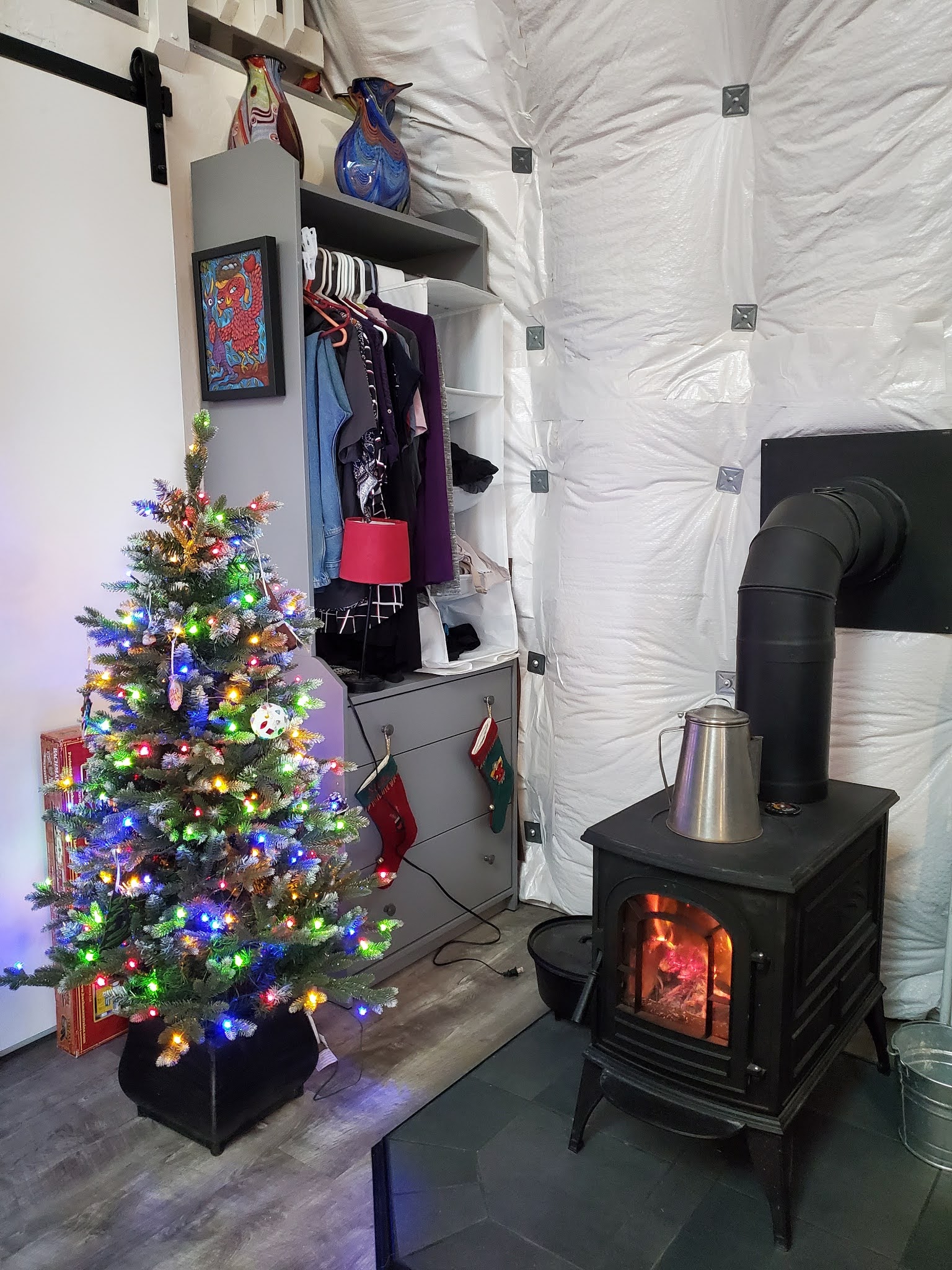
So since we have snow and a fire in the stove it really seemed like we ought to set up a Christmas tree.  We've never set up a tree with our kids.  For the past three years we were in the RV and we had a tiny ceramic tree and before that we just didn't have one...so this is the first year we have one.  


Another plus of the stove being lit is that I can cook on the surface.  I have made all kinds of things, tacos, pasta, hashbrowns, beans, fried rice - it is way better than trying to cook on my outdoor stove which looked like this when it snowed.  Of course cooking on a wood-burning stove is also much warmer (especially on one's legs)!


With burning wood comes the need to chop wood.  Thankfully we have a lot of dead wood on our property and we are now able to clean it up and put it to use.  


Also, we finally got the backhoe on the tractor and it has come in handy for digging up stumps after we cut down dead trees...

...and haul cut wood back to the pile.


Husband has been cutting and chopping wood...I drive the tractor and help stack :)  Life on the land is peaceful, safe from COVID-19, and full of beautiful scenes. 


Of course our time at the homestead is limited by time in the valley.  Halloween was spent in the city and we enjoyed a local art scavenger hunt in Mesa in lieu of trick-or-treating.


The cycle of life has also been on the forefront of our minds this winter as my grandma passed away two weeks ago.  She was 92 years old, living independently in the house she had lived in for the past 35 years, and relatively healthy until the last months.   She died in her home, under the care of hospice and my parents for her last weeks.  She was dear to me and I value the many times we had together including the year I spent living with her in my freshman year of high school so that I could attend a better school.  Her house is the most consistent one in my life; one that I have visited, slept over at, and lived in (for a school year) since I was 9 years old.  I last saw her in December of 2019.  The kids and I visited and celebrated Brother's 10th birthday. I am sorry it had been almost a whole year since I last saw her.  Here is the last picture I took of her.  Due to COVID-19 the family had a graveside service and will hold a memorial in the spring (hopefully a vaccine will be available then).  I hope we can attend the memorial.  Her life ends as this eventful year, which isolated her from the family, comes to a close.  Her sensibilities and understandings were of times past.  She was not progressive in her thinking and we disagreed on some major issues.  She was overly sensitive, she would cry easily over happiness or sadness.  We also had many very funny times and fun travels.  She embodied hardships that she could not, or would not, speak of.  She did not understand many of my motivations or choices, but she loved me.  She last visited AZ in 2017.  She flew, although she hated to fly, to attend my doctoral graduation ceremony.  It meant so much to me.  She will be missed, but we were blessed to have been touched by a life such as hers.  Goodbye grandma.  I love you.


Sunday, October 18, 2020

Updates from the Rancho

The other morning, as I took kitchen scraps to the compost I glanced down the hill to the to the west and could see a few pronghorns grazing in the morning sun.  Tonight, like most nights spent on the homestead, I spent some time admiring the planetarium that I live in.  


After spending three years living in an RV and traveling to 40+ National Parks, it is really wonderful to live in a nature preserve with no monthly expenses (except trash).  The closest National Park to our land is the Petrified Forest and we find ample evidence around us of the ancient forest that used to flourish here. The Ancient peoples who called this place home left their artifacts and teach us that we are all just passing through while Mother Earth endures.  We seek to leave a positive imprint on this piece of nature and are proud that while the average American household uses around 877 kWh, this homestead uses around 150 kWh each month (~17% of what most American households use).  

In new news, we added a shipping container to the homestead which serves as a garage for our two vehicle.  A month ago the rodent activity was very high and we saw evidence of the critters in our vehicles.  We are really happy with the sealed indoor space and the rodent problem has been eliminated.  We like the container a lot and are actually considering a second one....I've been reading how people make greenhouses in them!  My container garden was utterly devastated by the wildlife.  Next year I need an indoor grow space for veggies.  Outside we want to start planting an orchard, but we need to fence in our property to keep cows and pronghorn away. 


In other exciting news, we had our wood burning stove installed!  We have been chopping wood in preparation for winter (it's a work in progress, we need a lot more).  The weather has been very warm for October - today the high was 84.  Even with lows in the 40s we are comfortable inside without the stove at this time.  


Sister has cowgirl boots - they are good for playing in the sand and exploring the high desert! Brother is growing his hair long - he wants to be able to put it in a ponytail.  Homeschooling is going well, we are in a comfortable routine.  When we are here homeschooling works well, we have more room to spread out.  We are thankful that Verizon has expanded coverage to this area.  The hotspot data works pretty well.  

For the past three years (while living FT in the RV) we rented a 5x5 storage space - the rest of our stuff has been stored here.  This past weekend we finally cleared out the storage and brought the rest of our property here.  While we are still tied to the valley (we stay in the RV), it is nice to see things that were boxed three years ago - when we moved from our 4000 square foot house - unboxed and put in their new places!  

Tonight, on solar power, we are listening to vinyl!


Husband installed a security system with multiple cameras that are motion activated and connected to the internet.  When we are in the valley we can monitor the homestead in real time and receive notifications if anyone is on the property.  This gives us a lot of piece of mind when we are away.  

In many ways the pandemic, while terrible and terrifying, ironically has allowed us the freedom to finish this long work in progress.  Working on our homestead has also been a great source of comfort and has been really good for my mental health.  A self-sufficient debt-free existence has certainly been a worthwhile pursuit on many levels.  Here we have created the systems upon which we rely - instead of being subject to the fallibility of end-stage capitalism.  Each day there are projects and tasks we have set for ourselves as we build into existence the the ideas of yesterday.  

Nature is profound and near here.  We are the minority infringing on the sacred spaces which belong to the critters.  


The darkness is a force, the phases of the moon are a part of our day - the full moon cast shadows from the trees and none but the brightest starts are visible.  In the new moon the deafening silence of the milky way transports the thoughts to infinity.  

Early September Moonrise

This is how we are supposed to live.  The city is sick.  It dulls our senses with consumerism and noise. Here we are free.  Here we live with the patterns of the sky, not in defiance of them.  We cannot trap ourselves indoors; we are forced to reckon with the elements.  This world is all we have, we owe it our lives.  We can be good stewards or we can greedily swallow up more and more until we are fat and sick and we have left destruction in our wake.  There are cycles that continue to exist even if they are ignored - best we open our eyes and learn to live with the cycles to avoid becoming victims of our own hubris and greed.  Nature out of balance is a force that will knock us down if we cannot cooperate. Have we not learned from the past?  We must rediscover that which was known by the ancient peoples - that Mother Earth is not something to be taken for granted - quite the opposite! She is sacred.  We do not own Mother Earth, we are owned.  We are animals pretending to be gods.  We must change course.  We must remember.  We must be stewards.  What can you do to bring balance to that which is so terribly tipped?  

Sunday, September 6, 2020

Solar system performance

The solar system is performing very well.  It is rated for 4-5 kWh per day.  During one week, on the sunniest day we got 6 kWh from the panels; on partly cloudy day we got just under 4 kWh.  


We have a 24V battery bank with a rating of 420 amp hours - we can draw about half of the amp hours overnight if they are fully charged.

Our main draws on the system are:
  • Delivery pump for water
  • Dometic chest fridge/freezer
  • Fans
  • Coffee pot in the AM - if sunny
  • WeBoost cellular signal booster
  • Batteries of three laptop computers, three phones, two Nintendo Switch units
  • Xbox (part of the day)
  • TV x2 (part of the day)
  • microwave - intermittently - if sunny
  • Lights
I can also use kitchen appliances such as a coffee grinder, mixer, and food processor during the day when it is sunny.  Cooking with the sun and a propane grill (no ability to cook indoors) takes a bit of an adjustment.  I also have to adjust to a much smaller fridge.  
The kids have been happy that video games are still available to them on a solar system.  They also get a fair amount of time outdoors.

One of the amazing things about living off of the sun is taking a shower with solar hot water.  Today, though it was cloudy most of the day the hot water was at 110 degrees F. On sunny days the water temps at 130 degrees F.  The water stays very warm overnight despite the evenings getting cooler.  I am very curious about how the solar water heater will perform in the winter.  

Life on the homestead is relaxed.  There was such an amazing push to get all the systems complete and now we are enjoying the fruits of our labor.  While there are still many projects on the list it is satisfying to take a break and enjoy the fact that we are able to live in this space with all of our conveniences after over 20 years of camping.  Though we are currently traveling between our trailer in Mesa and the land due to my job, it is my hope that one day we will be able to reside at the homestead full-time.  During the long weekends we can catch a glimpse of the full-time simple life.  With the temperatures in the Phoenix area breaking all kinds of records and with the struggle to keep the trailer cool in those conditions we welcome every moment we can escape to the mountains.  

Soon we will get our wood-burning stove installed!  We are really looking forward to spending the winter break in our cozy cabin.